
Productivity
Mind Map for Project Management
Plan a project in one page with a free project planning mind map — scope, tasks, owners, and risks visible together. No login, no install.
Quick answer: For project management, put the project goal in the center of a mind map and branch into features, tasks, owners, timeline, and risks. Mind Map Online is free, runs in your browser, and exports the finished plan as PDF, PNG, SVG, or JSON.
One-page project overview
Goals, scope, tasks, owners, and risks on a single screen. Stakeholders understand the whole project in thirty seconds instead of a 20-slide deck.
Brainstorm before committing
Pressure-test an idea before writing the plan: features, must-haves, nice-to-haves, and blockers all visible. Rearranging is drag-and-drop.
Export to share
Export the map as PNG for Slack, PDF for meeting handouts, or SVG for editing in design tools. No watermark, no paid tier.
Recommended structure
A project map works best with this skeleton — add branches as your project needs:
- ✓ Features — must-haves and nice-to-haves in separate branches.
- ✓ Tasks — this week, backlog, and blockers with owners on each node.
- ✓ Risks — technical and scope concerns that could move the date.
- ✓ Wins — milestones and shipped items to keep the team motivated.
Start from the Project Brainstorm template or the Product Roadmap template for quarter-based planning, and read how to create a mind map online if you are new to the format.
Example map: Website launch project
Map the whole project before writing a single task. Central idea "Website launch" with branches Design, Development, Content, and Marketing. Break Development into Frontend, Backend, and Testing sub-branches, attach owners in notes, and use the exported map as the single source of truth in kick-off meetings.
How teams use mind maps for projects
- 1
Define the outcome
Put the goal in the centre as a result and a date — “Launch v2 by March”.
- 2
Branch into workstreams
Each workstream becomes a branch; tasks become sub-branches with an owner.
- 3
Turn branches into a plan
Export the map, then move each branch into your tracker as an epic or a task list.
Three rules for a project map
- Keep the map at workstream level — details belong in the tracker, not on the canvas.
- Add a Risks branch from the start; it is the branch teams forget until launch week.
- Re-open the map at every milestone to see what moved and what stalled.
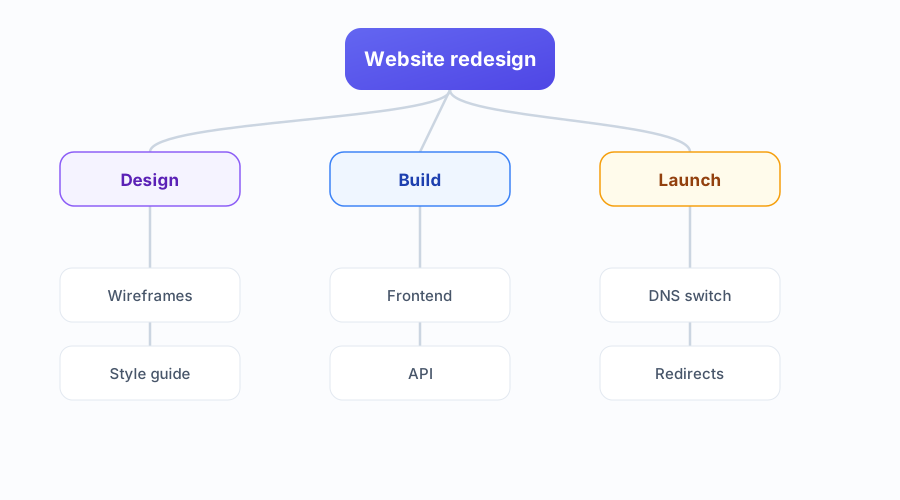
Worked example: a website redesign
“Website redesign” sits in the centre, with branches for Design, Content, Development, Launch and Risks. Under Launch you list the DNS switch, the redirect map and a rollback plan — the three things behind most launch-day incidents. Naming a risk on the map is what turns it into a task someone owns.
FAQ
How do you use a mind map for project planning?
Put the project goal in the center, then branch into scope, tasks, owners, timeline, and risks. Nest specific action items under each branch. The result is a one-page project overview you can share and update as the project moves.
Is a mind map better than a project spreadsheet?
For the planning phase, yes — a map shows dependencies and scope visually, and reorganizing ideas is drag-and-drop. Spreadsheets are better for tracking numbers; keep both: plan in the map, track in the sheet.
Can I use a mind map for agile planning?
Yes. Use the Project Brainstorm template to collect features, this-week tasks, and backlog in one view, then move concrete items to your sprint board. The map stays the big picture while the board tracks execution.
Is a mind map better than a Gantt chart for projects?
They answer different questions. A mind map shows scope and structure — what the project contains. A Gantt chart shows sequence and timing. Plan the scope on a map, then schedule it.
How do I keep the map and my tracker in sync?
Treat the map as the source of scope and the tracker as the source of status. Update the map when scope changes, and re-export it rather than maintaining two sets of tasks.
Can I share a project map with my team?
Yes. Export it as PNG, PDF or SVG and share the file. For live collaboration you would need a cloud whiteboard; for planning alone, a static map is enough.