
Students
Mind Map for Exam Prep
Finish your revision sprint with a free exam prep mind map — built around what you still cannot answer, not what you already know.
Quick answer: For exam prep, map each subject with branches for formulas, tricky questions, and retry lists, then revise until the retry lists are empty. Mind Map Online is free, needs no login, and exports your revision map as a printable PDF.
Active recall by design
A revision map forces you to recall and connect — the strongest study technique. Rebuilding it from memory beats re-reading every time.
Gaps become visible
If a branch stays empty, that is the topic you actually need to study. Linear notes hide those gaps between paragraphs.
Printable cheat sheet
One page per subject, formatted and ready: export as PDF for printing or PNG for your phone.
Build your revision map
- ✓ Topics — one branch per subject chapter, in exam weight order.
- ✓ Formulas — every equation you must recall, with units.
- ✓ Tricky questions — the ones you got wrong in practice, with the fix.
- ✓ Retry lists — revisit until empty. That is when you are ready.
Start from the Exam Revision template or the Study Notes template , and follow the full study workflow in our students guide .
Example map: History exam prep
Build one map per exam topic and review it the night before. Set the central idea to "World War II", then branch out Causes, Key events, Leaders, and Aftermath. Under Key events, list D-Day, Stalingrad, and the atomic bomb with one-line notes. Use colors per theme (green for causes, blue for events) so your brain links color to category during the exam.
How to use mind maps for exam prep
- 1
Map the syllabus
One branch per syllabus section, so you can see what exists and what you have not touched.
- 2
Compress each section
Reduce every branch to only the facts you would actually write in an answer.
- 3
Recall, then prune
Cover the map, recall a branch aloud, then delete what you already know and revisit only the rest.
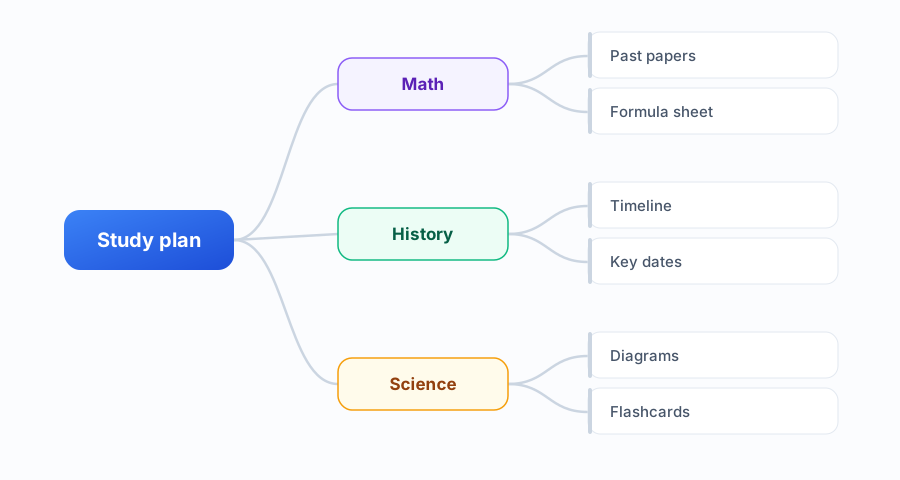
Three ways to make prep more efficient
- Start from past-paper questions and build the map around what gets asked.
- Keep a “red” branch for topics you keep getting wrong; review it first.
- Re-draw the map from memory once — it exposes gaps faster than re-reading.
Worked example: a biology revision map
“Cell division” sits in the centre, with branches for Mitosis, Meiosis and Comparison. Under Comparison you place the differences that examiners ask for: number of divisions, chromosome number, and where each happens. Building the comparison branch is what turns two separate topics into one answer you can write under time pressure.
FAQ
How do you use a mind map for exam preparation?
Put the subject in the center and branch into topics. Under each topic, list formulas, tricky questions you got wrong, and a retry list. Revise from the map until the retry lists are empty — then export it as a printable PDF.
Is mind mapping better than re-reading notes?
For active recall, yes. Rebuilding a map from memory is a strong retrieval exercise, and a map shows gaps immediately. Re-reading notes feels productive but tests nothing — a map tests your memory by design.
Can I print the revision map as a cheat sheet?
Yes. Export the finished map as PDF and print it — one page holds a whole subject. PNG works too if you want it on your phone for bus-time revision.
Are mind maps better than flashcards for exam prep?
They do different jobs. Flashcards drill isolated facts; a mind map shows how topics connect and where comparisons are made — which is what longer answers reward. Use both: map first, then make cards from the branches you forget.
How early should I start mind mapping before an exam?
Early enough to build the map once and review it a few times — usually two to three weeks out for a full subject, more for a heavy syllabus. The review passes matter more than the first build.
Can I use the map during the exam?
No, but the structure is what you recall. Re-drawing a branch mentally, in the order you built it, is often faster than trying to remember a paragraph of notes.