
Students
Mind Map for Students
Turn lectures and textbooks into clear study mind maps — free, online, no account. Take notes visually, revise faster, and export maps for printing.
Quick answer: Students use Mind Map Online to take lecture notes, plan essays, and revise for exams — all in the browser with no login. Start from a ready-made study template, add your subject and key points, then export as PDF, PNG or JSON.
Lecture notes in real time
Capture key points and questions as the lecturer speaks. The map shows the structure of the lecture as it happens — no re-reading long paragraphs later.
Faster revision
A single revision map replaces twenty pages of notes. Rebuild it from memory, compare with the original, and print a PDF cheat sheet before the exam.
Essay & project planning
Map your argument or project before writing: thesis in the center, main points as branches, evidence and sources as leaves.
Start with a study template
Ready-made layouts save you the blank-canvas moment. Both templates below open on the canvas with one click and every node is editable.
- ✓ Study Notes template — concepts and resources on one side, practice and exam prep on the other.
- ✓ Exam Revision template — formulas, tricky questions, and retry lists for the final stretch.
- ✓ Lecture Notes template — key points, questions, and summary in three columns.
Prefer the full workflow? Read our step-by-step guide to mind mapping for students .
Example map: Biology revision
A revision map works best with one topic per map. Open the maker, set the central idea to "Cell Biology", then add branches for Organelles, Photosynthesis, Cell division, and Transport. Under Photosynthesis, add sub-branches for Light reactions and the Calvin cycle. Apply a pastel theme, export as PNG, and keep it on your phone for quick review between classes.
How students use mind maps
- 1
Start from the topic
Put the subject or exam topic in the centre — one topic per map, not one giant map per subject.
- 2
Branch per subtopic
Give each chapter or theme its own branch, then add key facts as sub-branches.
- 3
Compress, then recall
Rewrite each branch in your own words, cover the map, and recall it. That is active recall on a single page.
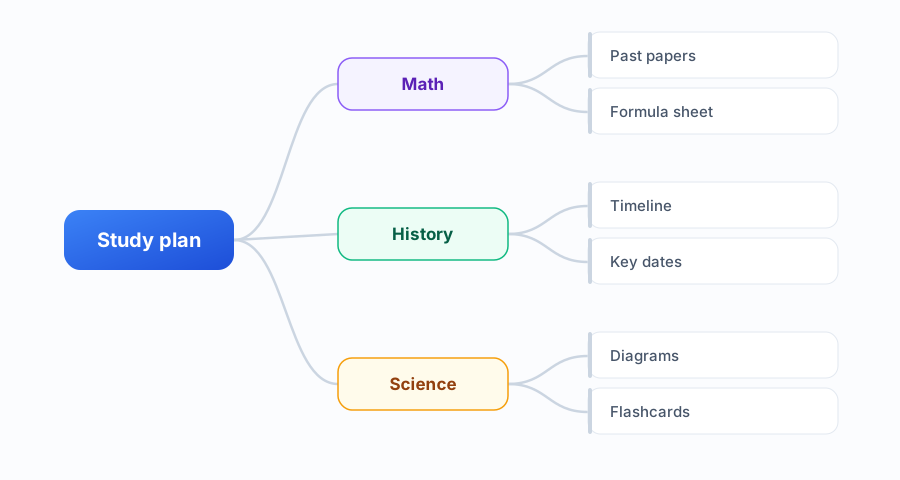
Three habits that make study maps work
- One map per topic keeps review sessions short and focused.
- Use one colour per theme, and keep the same colour across your maps.
- Add a “weak spots” branch after every practice test, and revisit that branch first.
Worked example: a history revision map
“Causes of World War I” sits in the centre, with branches for Militarism, Alliances, Imperialism and Nationalism, plus a short-term branch for the assassination. Under Alliances you list the two blocs and the treaties. That branch structure is almost exactly the shape of a strong exam answer, which is why it is easy to recall under pressure.
FAQ
How do students use mind maps?
Students use mind maps for lecture notes, exam revision, essay outlines, and project planning. A map shows the main topic in the center with key points as branches, which makes connections visible that linear notes hide.
What should a study mind map include?
Put the subject in the center, then branch into core concepts, definitions, key terms, resources, and practice material. Keep labels short — one idea per branch — and add colors to group related topics.
Is a mind map good for exam revision?
Yes. Revision maps turn a textbook into a single scannable page, and rebuilding a map from memory is one of the most effective active recall exercises. Export it as a printable PDF cheat sheet.
Are mind maps good for exam revision?
Yes. They force you to group and compress information, which is exactly what recall asks of you. Build the map while studying, then review only the branches you keep forgetting.
Should I hand-draw my study maps or use a tool?
Hand-drawing can help memory, but it is slow and hard to update. A browser tool is faster to edit and lets you restructure a branch in seconds when your understanding changes.
How many mind maps should I make per subject?
One per topic is the usual sweet spot. A single map per subject becomes too large to review; a map per paragraph is too fragmented to show connections.