
Writing
Mind Map for Writing
Plan articles, essays, and books with a free writing mind map — structure the whole piece before you type the first paragraph.
Quick answer: Writers use Mind Map Online to outline articles and essays: topic in the center, sections as branches, research and examples as leaves. It is free, needs no login, and exports the finished outline as PDF, PNG, SVG, or JSON.
Outline before writing
Hook, thesis, body points, and conclusion structured visually — rearrange with drag-and-drop until the argument flows.
Research attached to sections
Each section branch carries its own sources and examples, so nothing is lost between research and drafting.
From map to draft
Walk the map branch by branch and write. Keep it open beside your editor, or export the outline as a PDF reference.
A writing map that works
- ✓ Topic in the center — one sentence that captures the piece.
- ✓ Outline branch — sections in order, each with its supporting points.
- ✓ Research branch — facts, quotes, and links grouped by section.
- ✓ Conclusion — the takeaway you are writing toward, visible from the start.
Start from the Content Outline template or the Book Summary template for nonfiction, and see how the map method compares in our mind mapping in Word guide .
Example map: Essay outline
Outline an essay as a map before drafting. Central idea "Climate change essay" with branches Introduction, Causes, Effects, Solutions, and Conclusion. Under Causes, note greenhouse gases and deforestation; under Solutions, list renewables and policy. The map becomes your paragraph order — drag branches to reorder the essay structure instantly.
How writers use mind maps
- 1
Thesis in the centre
State the argument or the point of the piece as a single sentence.
- 2
One branch per section
Add a branch for each section, scene, or argument; sub-branches are the points inside it.
- 3
Re-order before you write
Drag branches into a logical order, then use the map as your outline — the writing gets much faster.
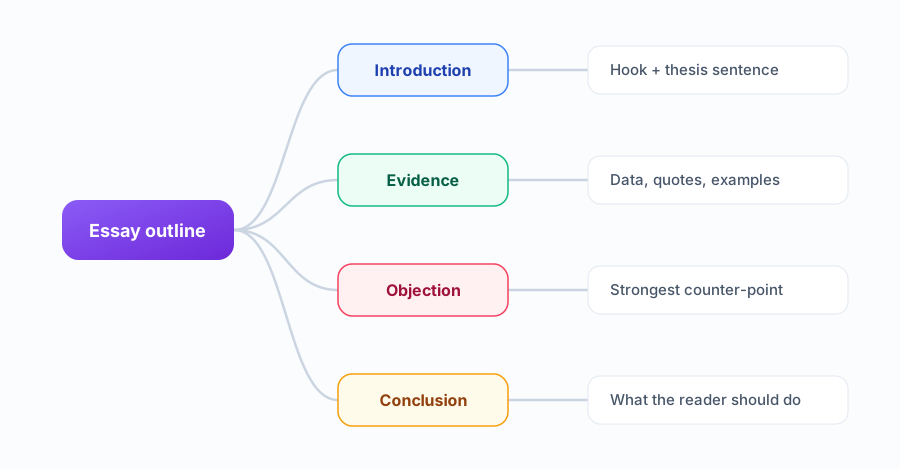
Three things that keep an outline honest
- If a branch has no evidence under it, the argument is not ready.
- Keep the thesis branch visible while you write so tangents get caught early.
- Move a branch the moment it feels out of order; rearranging is cheap on a map.
Worked example: outlining an article
“Why we write outlines” sits in the centre, with branches for Problem, Evidence, Method and Objection. Under Objection you put the two strongest counter-points — writing them down early stops you from dodging them later. When you export the map, the branch order becomes your section order.
FAQ
How do writers use mind maps?
Writers use mind maps to plan before writing: the article or book idea goes in the center, main sections become branches, and supporting points, examples, and sources hang off each section. The map replaces a blank-page stare with a visible structure.
What is a content outline mind map?
A content outline mind map is a visual outline: hook and thesis near the center, body sections as branches, and research, examples, and the conclusion as leaves. You write the article by walking the map branch by branch.
Is mind mapping faster than linear outlining?
For most writers, yes. Rearranging sections is drag-and-drop instead of cut-and-paste, and seeing all sections at once makes it easy to spot missing arguments or repeated points.
Is a mind map better than a linear outline for writing?
For planning, usually yes — a map lets you move sections around without renumbering everything. For the draft itself, a linear outline still wins. Use the map to think, the outline to write.
How big should a writing mind map be?
Small enough to see at once. If branches run off the screen, group them under fewer top-level branches — three to five sections is a comfortable range for most pieces.
Can I export the map as an outline?
Yes. Export as PDF for a paper copy or SVG for crisp rendering, then use the branch hierarchy as your headings and bullet points when writing.