
Mind Map vs Concept Map
Both visualize ideas — but they work differently. Learn when to use a mind map vs a concept map.
By Duy Nguyen · Founder, Mind Map Online
Quick answer: Mind maps have one central topic with tree-like branches — best for brainstorming and note-taking. Concept maps have multiple nodes connected by labeled arrows — best for showing complex relationships. For most students and professionals, mind maps are faster and more practical.
Try free mind map maker →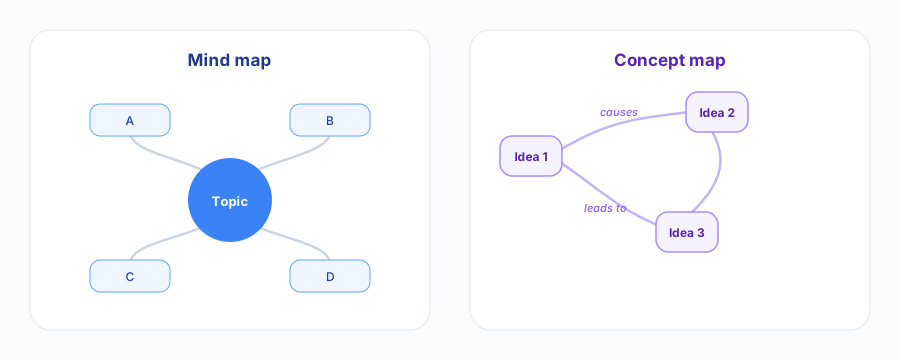
What is a mind map?
A mind map starts with a single central idea and grows outward into branches, then sub-branches. The links are unlabelled because the relationship is implied by position: anything hanging off a branch belongs to it. That makes mind maps fast to build and easy to scan — you read one like a table of contents.
What is a concept map?
A concept map starts from several concepts and connects them with labelled arrows — "causes", "leads to", "is part of". There is no single centre, and the same concept can link in more than one direction. The labels are the substance: they say how two ideas relate, not just that they are connected.
Key differences
| Aspect | Mind map | Concept map |
|---|---|---|
| Structure | Tree / radial, one centre | Network / web, multiple nodes |
| Connections | Unlabelled branches | Labelled arrows (e.g. "causes") |
| Starting point | One central idea | Several key concepts |
| Depth | Hierarchical, top-down | Cross-linked, non-hierarchical |
| Best for | Brainstorming, studying, planning | Systems, processes, research |
| Creation time | Fast (2–5 min) | Slower (each link needs a label) |
| Reads like | A table of contents | A map of how things relate |
| Origin | Tony Buzan (1970s) | Joseph Novak (1972) |
When to use a mind map
- Brainstorming a new topic, talk, or article — capture ideas in the order they arrive.
- Studying and revision — one branch per subtopic, easy to scan before an exam.
- Project planning — break a goal into workstreams, tasks, and owners.
- Meeting notes — an agenda and its decisions in a structure you can revisit.
When to use a concept map
- Explaining cause and effect — "A causes B, which leads to C".
- Mapping a system — how parts of a process or an organisation interact.
- Linking theory to evidence when the relationships matter as much as the items.
- Teaching a subject where several concepts connect in more than one direction.
Which should you use?
If you are capturing, grouping, or revising, use a mind map — it is faster and the structure does the work. If you are explaining how things influence each other, use a concept map, and accept that it will take longer because every link needs a label. A useful rule: start with a mind map to get everything down, then add cross-links between branches only where a relationship really matters. That hybrid captures the speed of a mind map with the insight of a concept map.
FAQ
What is the difference between a mind map and a concept map?
A mind map has one central topic with branches radiating outward in a tree structure — ideal for brainstorming and note-taking. A concept map connects multiple concepts with labeled relationship arrows, forming a network — better for showing complex systems and relationships between ideas.
Mind map vs concept map — which is better for studying?
Mind maps are generally better for studying because they’re faster to create, easier to review, and mirror how the brain organizes information hierarchically. Concept maps work better for subjects with many interconnected concepts, like biology systems or historical cause-and-effect.
Can I create both mind maps and concept maps online?
Mind Map Online is optimized for mind maps with tree structures, auto-layout, and aesthetic themes. For concept maps, you can manually create cross-links between nodes, though the tool is primarily designed for mind map structures.
What does a concept map look like vs a mind map?
A mind map looks like a tree or radial diagram with one center. A concept map looks like a network or web with multiple connected nodes and labeled arrows between them (e.g., "causes → leads to → effect"). Concept maps are more complex and less hierarchical.
Who should use a mind map vs a concept map?
Students studying for exams → mind maps (fast, hierarchical). Researchers analyzing systems → concept maps (shows relationships). Project managers planning tasks → mind maps (tree structure). Scientists modeling processes → concept maps (network of interactions).
Do concept maps need labelled arrows?
Yes — the labels are the point. An arrow without a label (like "causes" or "leads to") is just a line; the relationship is what a concept map communicates. If your arrows are unlabelled, you have a mind map or a spider diagram instead.
Can I turn a mind map into a concept map?
Roughly, yes. Capture everything in a mind map first, then add cross-links between branches to turn it into a concept map. The reverse — untangling a concept map into a clean hierarchy — is harder, which is why starting with the tree usually saves time.
Which is better for revision?
Mind maps suit most revision: they are fast to build and review, and their hierarchy matches how exam answers are structured. Reach for a concept map when the topic is a web of causes and effects rather than a clean list of subtopics.
How we compared
This comparison follows the standard definitions used in education and knowledge-management literature: mind mapping after Tony Buzan, concept mapping after Joseph Novak. The structured examples reflect how each is taught for study and research, not a single vendor’s feature list.
Last updated: September 19, 2026.
Keep exploring
Get the full background on what a mind map is , see mind map examples in practice, or create your first mind map online .